
Understanding medical courier chain of custody requirements in the UK has never been more critical for healthcare professionals, laboratory managers, and procurement teams. A striking 56% of lab directors, managers, and supervisors reported that a medical courier error compromised an irreplaceable specimen in the past year alone, making compliant, traceable logistics an absolute non-negotiable for anyone moving sensitive medical items across the country. Whether you are dispatching blood samples, pharmaceuticals, or diagnostic kits, a reliable same day courier with robust chain of custody procedures is the only way to protect patient safety and regulatory standing.
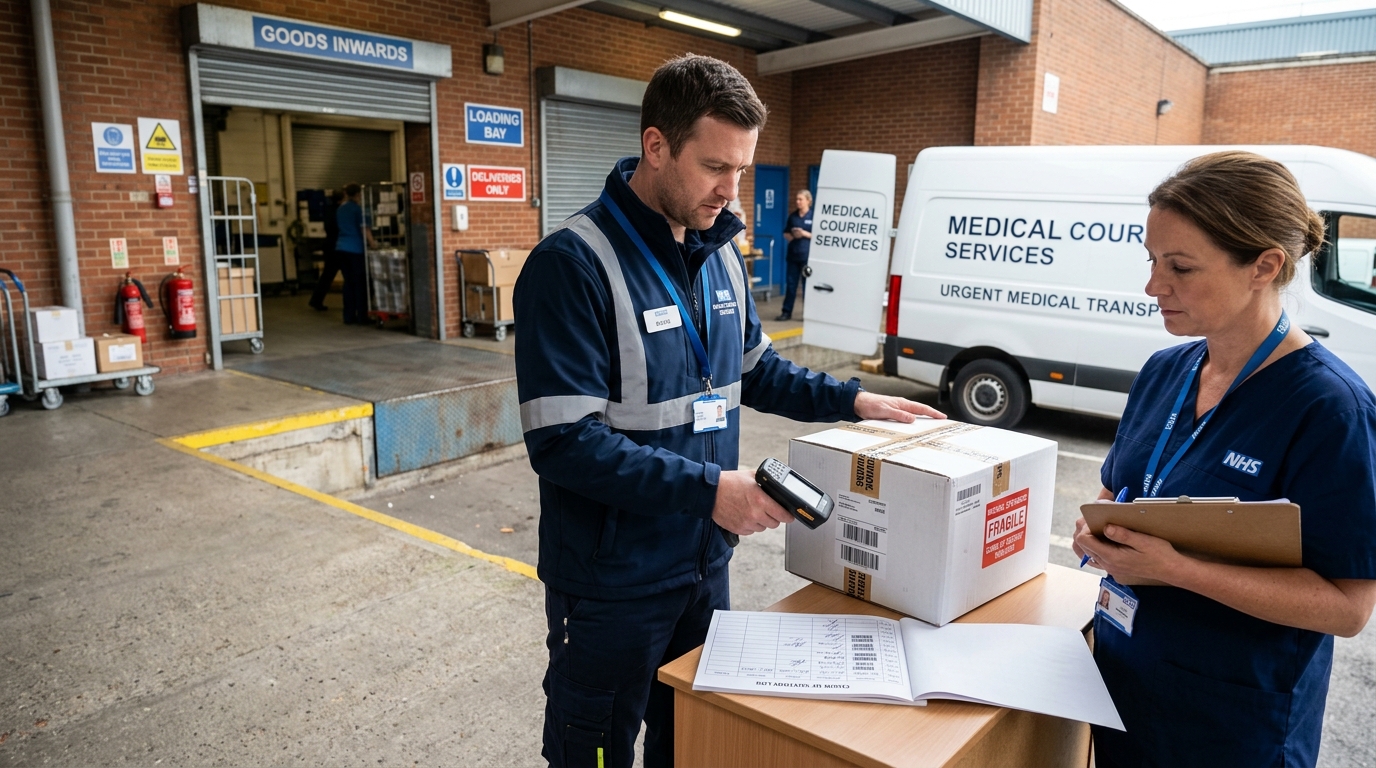
Key Takeaways
| Question | Answer |
|---|---|
| What is chain of custody in medical courier services? | A documented, unbroken record of who handled a specimen or medical item at every stage of transit, from collection to delivery. |
| Which UK regulations govern medical courier chain of custody? | The MHRA, Human Tissue Authority (HTA), GDPR, and GDP (Good Distribution Practice) guidelines all apply to medical courier operations in the UK. |
| Do medical couriers need to be licensed in the UK? | Yes. Couriers handling certain categories of medical items, including controlled drugs or human tissue, require specific licences and must maintain full audit trails. |
| What documentation is required for medical courier chain of custody in the UK? | Collection receipts, handover signatures, temperature logs, tamper-evident sealing records, and digital proof of delivery are all required. |
| Can a same day courier handle chain of custody medical deliveries? | Yes, provided the courier is licensed, insured, uses tracked vehicles, and follows documented handover and temperature-control procedures. |
| Why does temperature control matter for chain of custody? | Many specimens and medicines degrade outside specific temperature ranges. A break in cold chain integrity is a chain of custody failure and can render samples unusable. |
| How do I verify a courier meets UK chain of custody standards? | Request proof of MHRA compliance, GDP certification, insurance documentation, and ask for a sample chain of custody form and tracking capability overview. |
What Are Medical Courier Chain of Custody Requirements in the UK?
Medical courier chain of custody requirements in the UK refer to the legally and professionally mandated procedures that ensure every medical specimen, pharmaceutical product, or clinical sample is accounted for at each stage of its journey. From the moment an item is collected to the moment it is signed for at its destination, every transfer of responsibility must be documented and verifiable.
Chain of custody is not just good practice. In the UK, it is a regulatory obligation enforced across multiple frameworks, including MHRA Good Distribution Practice (GDP) guidelines, the Human Tissue Act, and GDPR requirements around patient data attached to specimens.
- Documented handovers: Every time a specimen changes hands, a signature and timestamp must be recorded.
- Tamper-evident packaging: Items must be sealed in a way that makes any interference immediately visible.
- Real-time tracking: The courier must provide live location data for the consignment throughout transit.
- Temperature monitoring: For temperature-sensitive items, continuous logging is required to prove cold chain integrity was maintained.
- Proof of delivery: A formal, timestamped confirmation of delivery to the correct authorised recipient is mandatory.
Why Medical Courier Chain of Custody Requirements UK Standards Exist
The stakes in medical logistics are extraordinarily high. A missed or corrupted specimen can delay a cancer diagnosis. A temperature breach on a critical drug delivery can render a treatment ineffective. These are not theoretical risks. They are documented, real-world failures that happen every single week across the UK.
UK chain of custody requirements exist to create accountability at every point in the process. If something goes wrong, the documentation trail identifies exactly where the failure occurred, who was responsible, and what action must be taken. This protects patients, healthcare providers, laboratories, and the couriers themselves.
“Your cargo’s safety is our top priority. We treat every medical consignment as if a patient’s outcome depends on it, because it very often does.”
For any organisation handling blood samples, diagnostic kits, pharmaceuticals, or human tissue in the UK, working with a specialist medical and pharmaceutical courier that fully understands these obligations is the only responsible approach.
Did You Know?
52% of nurses reported that a medical courier error or delay forced them to reschedule or cancel a clinical procedure in the past year.
Source: nihr.ac.uk
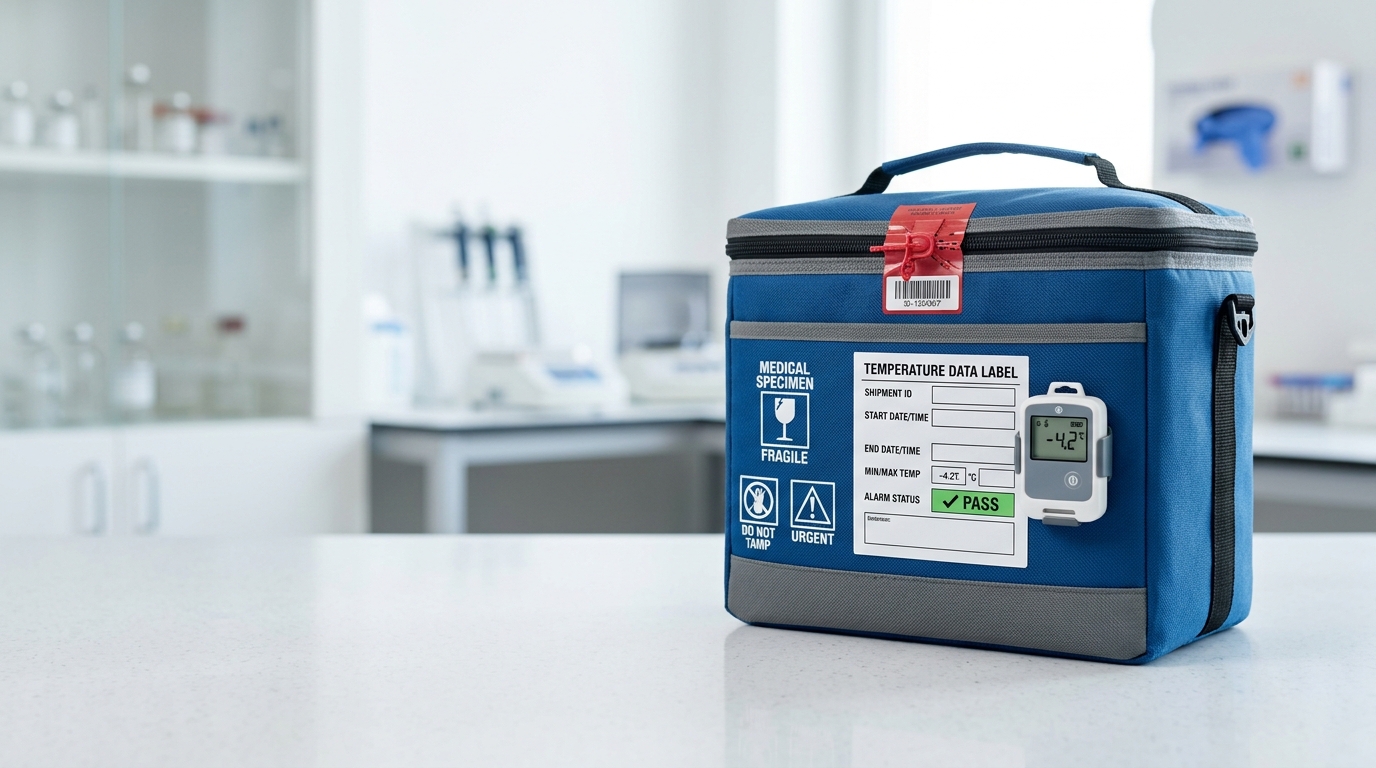
Key Documentation Required Under UK Medical Courier Chain of Custody Rules
Proper documentation is the backbone of any compliant medical courier chain of custody operation in the UK. Without the correct paperwork and digital records, a courier cannot demonstrate that an item was handled correctly, and any claims about specimen integrity become impossible to verify.
Here is what every compliant medical courier operation must maintain:
- Collection receipt and signature: Proof that the item was collected from the correct, authorised sender at a specific time and date.
- Chain of custody form: A running log that records every individual who has had physical possession of the item and at what time.
- Tamper-evident seal records: Documentation confirming the seal number and its intact status at collection and delivery.
- Temperature data logs: Continuous electronic records showing that temperature-sensitive items remained within required parameters throughout the journey.
- Proof of delivery (POD): A timestamped signature from an authorised recipient confirming safe receipt.
- Incident reports: Any deviation, delay, or anomaly must be formally recorded and reported to the commissioning organisation immediately.
We ensure all of these records are available on demand for every consignment we handle. No gaps. No ambiguity. A complete, auditable trail from collection to delivery.
Temperature Control and Cold Chain: Core Medical Courier Chain of Custody Requirements UK
Cold chain management is one of the most technically demanding aspects of medical courier chain of custody requirements in the UK. In 2026, 6 out of 10 new medicines being developed require refrigeration or strict temperature control during transit, making cold chain compliance a standard expectation rather than a premium add-on.
A break in temperature control is not merely a logistical inconvenience. It is a chain of custody failure. It means the item’s integrity can no longer be guaranteed, and the documentation record is compromised.
- Chilled specimens (2-8°C): Blood samples, certain vaccines, and diagnostic reagents typically require this range.
- Frozen specimens (-20°C or below): Certain tissue samples and biological materials require deep-freeze conditions during transit.
- Ambient-controlled transport: Some pharmaceuticals must be kept within a narrower ambient range (15-25°C) and must not be exposed to extremes.
Our temperature-controlled courier service uses dedicated refrigerated vehicles with continuous electronic monitoring, ensuring your cold chain documentation is unbroken and fully audit-ready.
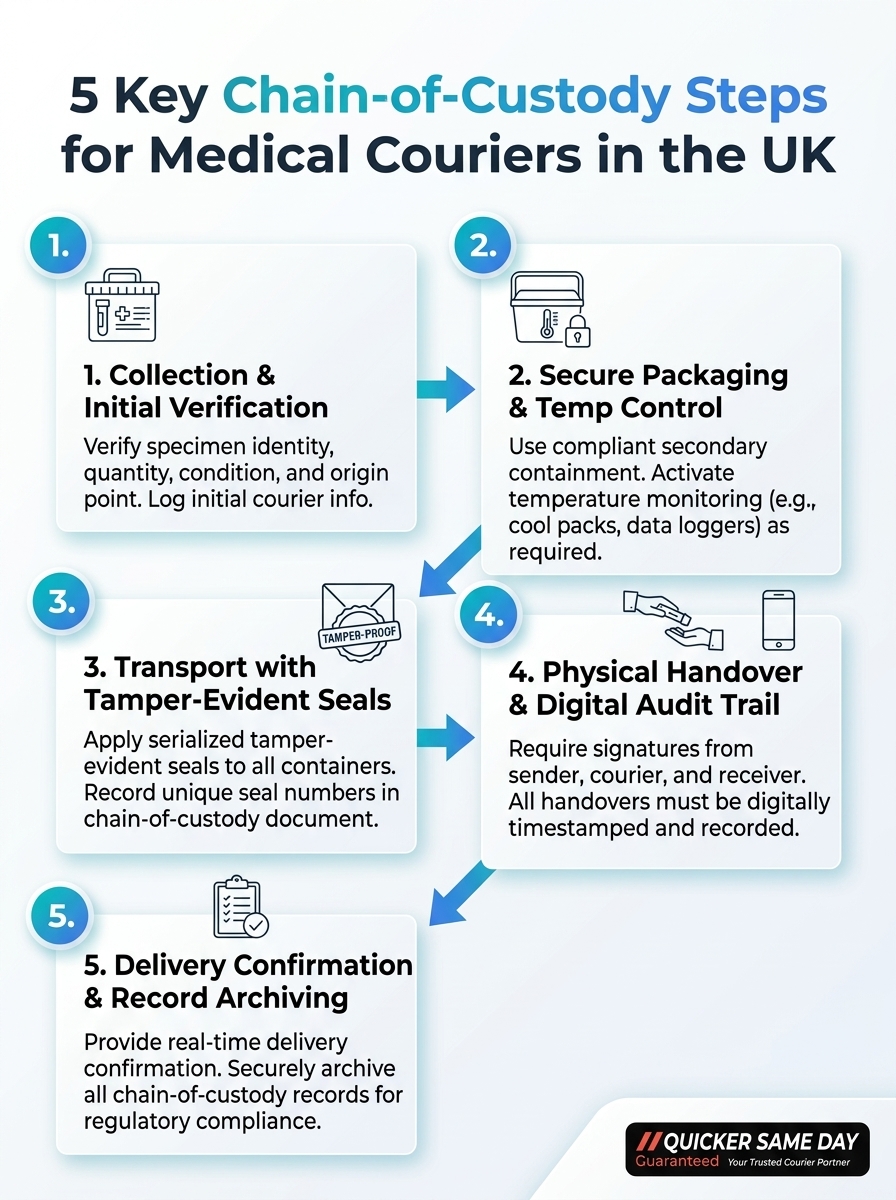
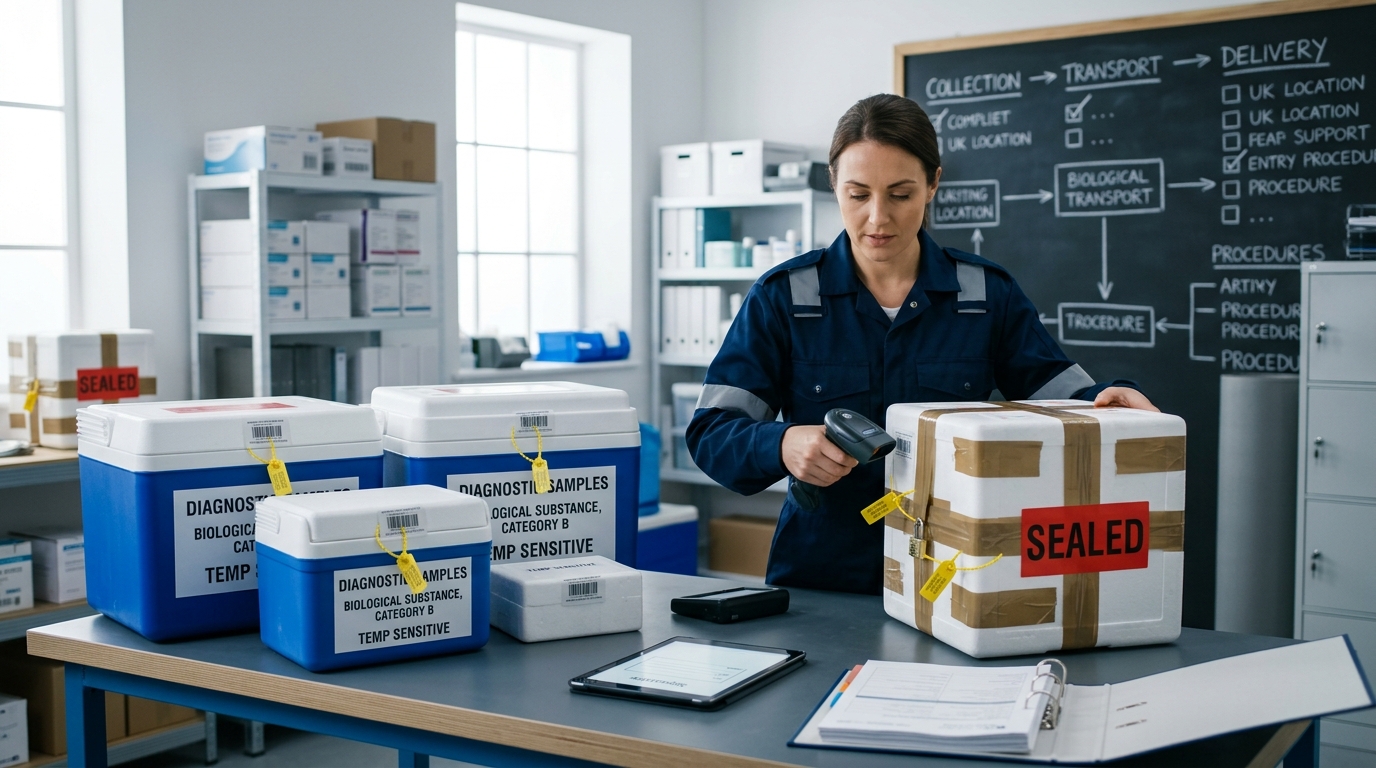
This infographic highlights the five essential chain-of-custody steps for medical couriers in the UK. It helps ensure specimen integrity and regulatory compliance.
MHRA and GDP Regulatory Framework for Medical Courier Chain of Custody in the UK
The Medicines and Healthcare products Regulatory Agency (MHRA) sets the regulatory framework that governs how pharmaceutical products must be handled and transported in the UK. Under Good Distribution Practice (GDP) guidelines, every party in the distribution chain, including couriers, must maintain standards that protect product quality and patient safety.
In 2026, UK compliance requirements cover the following core areas:
| Regulation / Framework | What It Requires | Applies To |
|---|---|---|
| MHRA GDP | Full traceability, temperature control, qualified personnel, documented procedures | Pharmaceutical product distribution |
| Human Tissue Act 2004 | Licensing, consent documentation, and chain of custody for human tissue transport | Human tissue and organ transport |
| UK GDPR | Secure handling of patient data attached to specimens or delivery instructions | All medical logistics involving patient data |
| Dangerous Goods Regs (ADR) | Safe packaging, labelling, and transport of Category B biological substances | Blood, tissue, and diagnostic specimens |
Choosing a courier that understands and operates within these frameworks is not optional. It is a fundamental requirement of any UK healthcare procurement decision in 2026.
How a Same Day Courier Service Supports Medical Courier Chain of Custody Requirements UK
Speed and compliance are not competing priorities in medical logistics. They work together. A same day courier service provides the fastest possible transit window, which directly reduces the risk of specimen degradation, temperature deviation, and documentation gaps.
The longer a medical item spends in transit, the more opportunities there are for a chain of custody failure. A dedicated same day courier with direct routing eliminates unnecessary handling points, reduces the number of handover stages, and significantly lowers the risk of a documentation break.
- Fewer handover points: Direct collection to delivery means fewer signatures required and fewer opportunities for an error.
- Real-time tracking: You can monitor the consignment’s location throughout the journey, with full audit trail availability.
- Rapid response to issues: If a problem arises (a traffic delay, a temperature alert), we can act immediately rather than waiting for a scheduled route update.
- Nationwide coverage: Whether you need a same day courier in London or a same day courier in Manchester, we collect within 30-60 minutes of your booking.
Best Practices for Maintaining Chain of Custody During Medical Transport
Meeting medical courier chain of custody requirements in the UK requires more than having the right paperwork. It demands a systematic, disciplined approach to every stage of the process. Here are the best practices that every compliant operation should follow in 2026.
1. Use tamper-evident, specimen-grade packaging. Every item should be placed in a sealed, labelled container that makes any interference immediately obvious. The seal number must be documented before collection.
2. Train all personnel in chain of custody procedures. Every courier driver, dispatcher, and handler must understand what chain of custody means, why it matters, and what to do if they identify a potential breach.
3. Use electronic proof of delivery systems. Paper-based records are vulnerable to loss, damage, and forgery. Electronic systems create timestamped, tamper-resistant records that satisfy UK audit requirements.
4. Maintain continuous temperature logs. For cold chain consignments, electronic data loggers inside the vehicle or packaging must record conditions throughout transit. These logs must be provided to the client upon request.
5. Establish clear escalation procedures. If a temperature breach, delay, or documentation discrepancy occurs, there must be a clearly defined process for reporting it immediately to the commissioning organisation.
Did You Know?
84% of lab professionals state that courier delays or errors impacted their ability to provide patient results in the last month.
Source: nih.gov

Same Day Courier Services Best for Urgent Medical Deliveries: What to Look For
Not every same day courier is equipped or qualified to handle medical consignments with chain of custody requirements. When evaluating a provider, there are specific capabilities you must confirm before entrusting them with sensitive clinical or pharmaceutical items.
Here is a clear checklist for healthcare procurement managers and laboratory administrators in 2026:
- Licensed and insured fleet: The courier must operate a fully insured, licensed fleet with vehicles appropriate for medical transport.
- Temperature-controlled vehicles: For specimens, blood, vaccines, or pharmaceuticals, refrigerated or temperature-monitored transport is non-negotiable.
- Real-time GPS tracking: You must be able to monitor the consignment’s location at any point during transit.
- Electronic proof of delivery: Timestamped, signed digital records must be available immediately after delivery.
- Out-of-hours availability: Medical emergencies do not respect office hours. Your courier must operate around the clock, every day of the year.
- Dedicated point of contact: A named contact who can respond immediately to any chain of custody query or incident is essential.
We handle urgent blood delivery, testing kits, and other sensitive medical items nationwide, with collection available within 30-60 minutes of booking. WE WON’T LET YOU DOWN.
Common Medical Courier Chain of Custody Failures in the UK and How to Avoid Them
Understanding where chain of custody failures most commonly occur is the first step to preventing them. In 2026, the most frequently reported failure points in UK medical courier operations are consistent and, importantly, entirely preventable.
Failure 1: Incomplete or missing documentation at collection. This happens when a courier arrives without the correct chain of custody forms, or the sender has not prepared the necessary paperwork. The fix is a standardised pre-collection checklist confirmed by both parties before pickup.
Failure 2: Temperature excursion during transit. Many couriers use vehicles without dedicated temperature monitoring, relying on passive cooling methods that fail in hot weather or extended journeys. The fix is dedicated refrigerated transport with continuous electronic logging, as provided through our temperature-controlled goods service.
Failure 3: Unauthorised handover at the delivery point. Delivering to an unauthorised or unverified recipient breaks the chain of custody regardless of how well the transit was managed. The fix is a strict delivery protocol requiring ID verification and authorised-recipient signatures only.
Failure 4: Poor incident reporting. When something goes wrong during transit, some couriers delay reporting or fail to report at all. The fix is mandatory, immediate incident notification with a documented response protocol.
Failure 5: Using a general courier for specialist medical logistics. General parcel couriers are not trained or equipped for chain of custody compliance. The fix is always using a dedicated, specialist medical courier with proven compliance credentials.
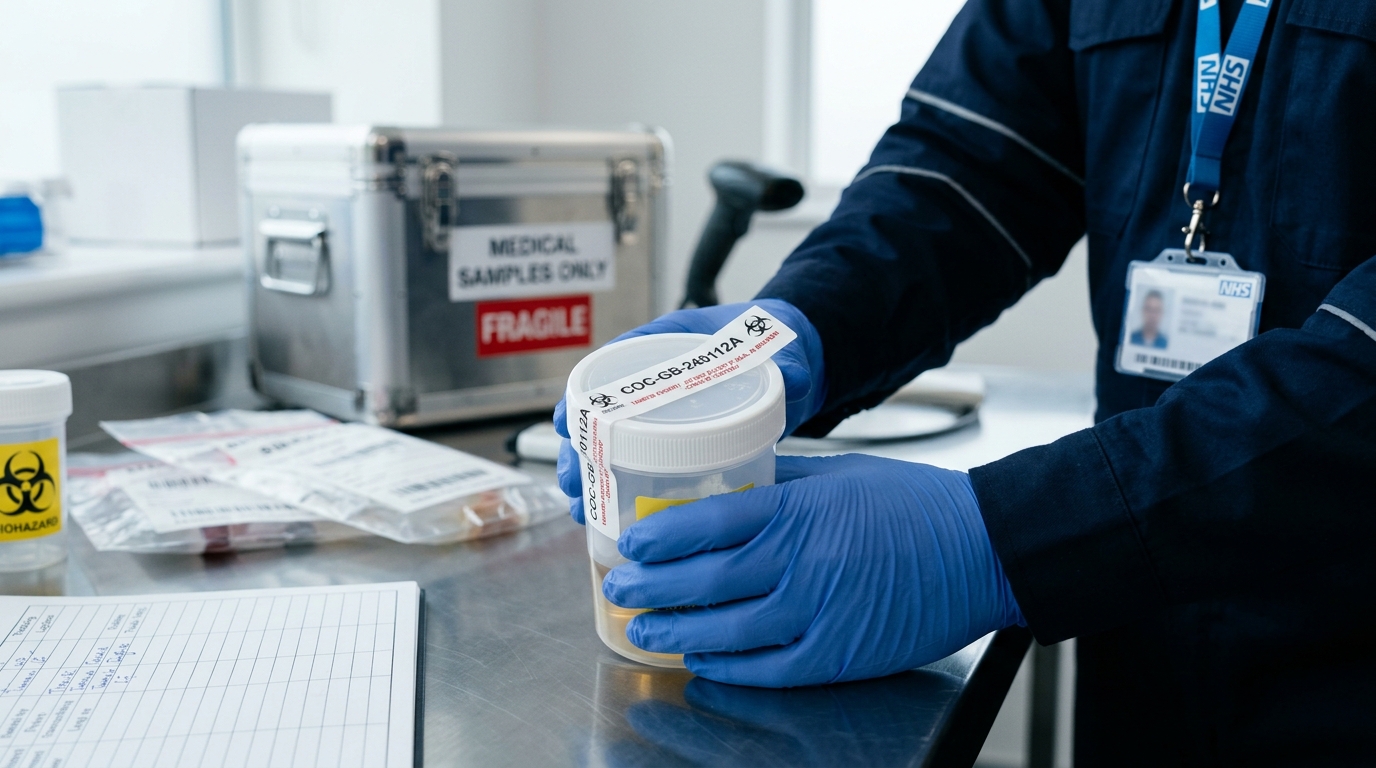
Medical Courier Chain of Custody Requirements UK: Regional Coverage Across the Country
UK medical courier chain of custody requirements apply equally whether you are dispatching a specimen from a city-centre hospital or a rural diagnostic clinic. Chain of custody does not have a postcode. The same standards apply everywhere, and your courier must be able to meet them regardless of location.
We operate from multiple hubs across the UK, providing rapid collection times and compliant chain of custody procedures nationwide. Our network covers all major cities and surrounding regions, including dedicated services for healthcare organisations across:
- London and the South East: High-volume medical logistics serving NHS trusts, private hospitals, and diagnostic laboratories with our London same day courier service.
- Manchester and the North West: Rapid medical collection and delivery across the region via our Manchester same day courier operation.
- Leeds and Yorkshire: Full chain of custody coverage for healthcare facilities across the region, supported by our Leeds same day courier team.
- Bristol and the South West: Compliant medical logistics with our dedicated Bristol same day courier service.
Nationwide collection within 60 minutes. Every consignment tracked, insured, and handled under full chain of custody protocols.
How to Choose the Right Courier for Medical Courier Chain of Custody Requirements UK
Selecting the right partner for medical courier chain of custody requirements in the UK is one of the most consequential procurement decisions a healthcare organisation can make. In 2026, there are over 1,000 medical courier companies operating across the UK, and the quality gap between the best and the worst is enormous.
Here is how to make the right choice:
- Request their chain of custody documentation pack. Any credible medical courier should be able to provide their standard chain of custody forms, incident reporting procedures, and temperature log templates immediately, without hesitation.
- Verify their insurance and licensing. Ask for certificates confirming they are fully insured for medical and pharmaceutical consignments, and licensed where required by the MHRA or HTA.
- Ask about their vehicle fleet. A strong fleet with temperature-controlled capabilities and GPS tracking is the operational foundation of compliant medical logistics. Our courier fleet is packed with the latest technology to ensure every route is always optimised.
- Test their responsiveness. Call them outside of standard hours. A medical courier that cannot be reached at 11pm is not suitable for healthcare logistics.
- Check their track record. Strong track record with numerous satisfied healthcare customers matters. Ask for references from NHS trusts, clinical laboratories, or pharmaceutical distributors.
- Confirm their same day capability. For urgent medical items, a same day courier with a guaranteed collection window is essential. Scheduled or next-day services are not appropriate for time-sensitive chain of custody consignments.
“We specialise in urgent time critical consignments. When you need a medical courier that understands chain of custody inside out, we are ready to collect within the hour.”
Meeting Medical Courier Chain of Custody Requirements UK with Confidence
The medical courier chain of custody requirements in the UK exist for one reason: to protect patients, clinicians, and the integrity of the healthcare system. In 2026, compliance is not a box-ticking exercise. It is a live operational commitment that must be demonstrated on every single collection and delivery.
From complete documentation and tamper-evident packaging to unbroken cold chain records and authorised-recipient delivery, every element of chain of custody matters. And every element is only as strong as the courier you choose to work with.
We offer licensed, insured, trackable same day courier services across the UK, with temperature-controlled vehicles, real-time tracking, and full chain of custody documentation as standard. Whether you are a hospital trust, a diagnostic laboratory, a pharmaceutical distributor, or a private clinic, we are ready when you need us.
Frequently Asked Questions (FAQs)
What happens if the chain of custody is broken during a medical delivery?
A break in the chain of custody means there is no longer a complete, verifiable record of who handled the item at every stage. In the UK, this can render specimens unusable, invalidate test results, and may trigger regulatory reporting requirements. In many cases, the sample must be recollected, causing delays to patient care.
Are medical courier chain of custody requirements legally enforceable in the UK?
Yes. Chain of custody requirements are enforced through multiple regulatory frameworks, including MHRA Good Distribution Practice (GDP), the Human Tissue Act, and UK GDPR. Non-compliance can lead to failed audits, fines, loss of licences, and reputational damage.
What types of medical items require a strict chain of custody?
Chain of custody applies to a wide range of items, including:
- Blood samples and pathology specimens
- Human tissue and organs
- Pharmaceuticals and vaccines
- Clinical trial materials
- Controlled drugs
If the item impacts patient care, diagnosis, or treatment, strict chain of custody is required.
How is chain of custody maintained during same day courier deliveries?
A compliant same day courier maintains chain of custody through:
- Signed and timestamped collection records
- Sealed, tamper-evident packaging
- Real-time GPS tracking
- Controlled transport conditions
- Verified proof of delivery
Fewer handover points in same day delivery actually reduce the risk of custody errors.
Do medical couriers need temperature-controlled vehicles for all deliveries?
Not all deliveries require temperature control, but many do. Items like blood, vaccines, and certain medications must be transported within strict temperature ranges (e.g. 2–8°C). If temperature control is required and not maintained, it is considered a chain of custody failure.
How long should chain of custody records be kept in the UK?
Retention periods vary depending on the type of material and applicable regulations. In general:
- Pharmaceutical distribution records (GDP): typically 5 years
- Clinical trial materials: often 15+ years
- Patient-related data (GDPR): must follow data minimisation and retention policies
Healthcare organisations should align retention policies with regulatory guidance and internal compliance requirements.
Can a standard courier service handle medical chain of custody deliveries?
No. Standard courier services are not equipped or trained to meet UK medical chain of custody requirements. They typically lack:
- Proper documentation processes
- Temperature monitoring systems
- Regulatory compliance knowledge
- Trained personnel
Using a non-specialist courier significantly increases the risk of failure.
What should I ask a courier before hiring them for medical deliveries?
Before choosing a provider, ask:
- Are you MHRA GDP compliant?
- Can you provide a sample chain of custody record?
- Do you offer temperature-controlled transport?
- Is real-time tracking included?
- What is your incident reporting process?
A reputable courier will answer all of these clearly and provide documentation.
Is digital tracking acceptable for chain of custody documentation?
Yes, and it is increasingly preferred in 2026. Digital systems provide:
- Real-time visibility
- Tamper-resistant records
- Automatic timestamps
- Easier audit access
Many UK regulators now expect electronic tracking as part of best practice.
What is the most common cause of chain of custody failure in the UK?
The most common issues include:
- Missing or incomplete documentation
- Temperature excursions during transit
- Delivery to unauthorised recipients
- Poor communication or incident reporting
All of these are preventable with a properly trained and compliant medical courier.
Do NHS organisations require specific courier standards?
Yes. NHS trusts typically require couriers to meet strict procurement and compliance standards, including GDP alignment, full audit trails, insurance coverage, and proven experience handling medical consignments.
How quickly should a medical courier respond to urgent requests?
For time-critical deliveries, a professional same day medical courier should offer:
- Collection within 30–60 minutes
- Direct, non-stop delivery
- 24/7 availability
Delays in response time increase the risk of specimen degradation and operational disruption.
Need help with Same-Day Delivery?
Choose Quicker Same Day to help you
No account necessary. Collection within 60 minutes. Transparent pricing with no hidden charges. Book your urgent medical delivery today and experience chain of custody compliance you can trust completely.